ISBN: 978-85-7670-267-2
Editora: Átomo
Autor: Igor Renato Bertoni Olivares
Edição: 1
Ano: 2016
Páginas: 140
Formato: 16 x 23 cm
Idioma: Inglês
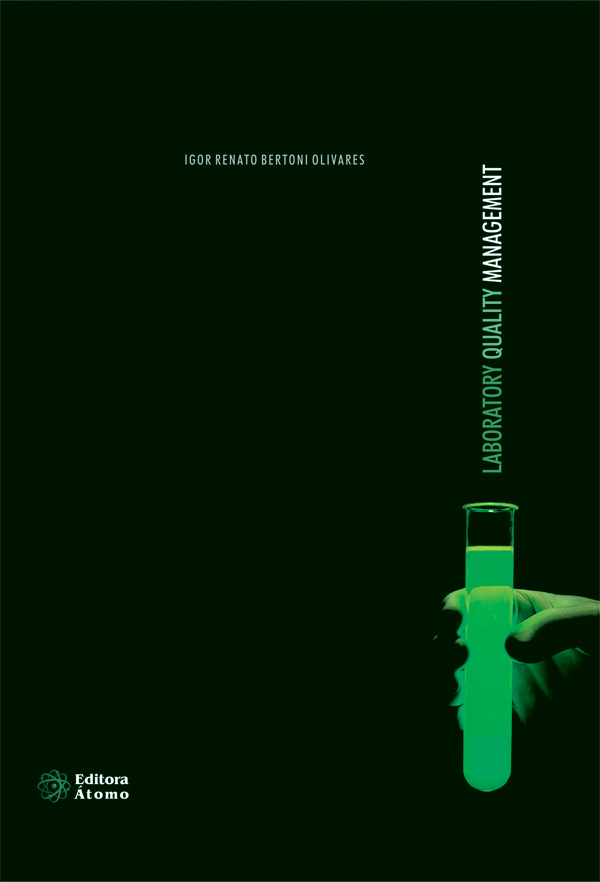
It is presently unthinkable to not take into account the need (sometimes mandatory) to implement Quality Management in Laboratories, either routinely or for research (basic and applied). Given that many countries have their own requirements regarding their mandatory implementation of Laboratory Quality Management Systems, this reality currently has a global reach to ensure the reliability of analytical results, especially since the effects of an analytical result can have major impacts on the environmental, pharmaceutical, forensic, clinical analysis, food areas, and so forth.
In light of the latest findings for Laboratory Quality Management, in this English edition of the book I intend to present this data in an informative manner, within the operating framework of a Management System, and in line with the proposal of being a book that provides assistance to the new professionals in this area (highlighting, for example, the evolution of concepts, needs and basic structure of a Quality Management System), as well as assist experts seeking new tools for Laboratory Quality Management (highlighting, for example, the Analytical Quality Assurance Cycle and Quality indicators concepts, in addition to the numerous tools applied to auditing, training, corrective action and others).

R$ 59,00
Para comprar este livro, faça login ou crie sua conta.
Entrar para comprarISBN: 978-85-7670-267-2
Editora: Átomo
Autor: Igor Renato Bertoni Olivares
Edição: 1
Ano: 2016
Páginas: 140
Formato: 16 x 23 cm
Idioma: Inglês
Foreword
Introduction
Chapter 1
Quality: evolution of concepts
Quality and quality management system – definitions
Chapter 2
Why Should a Quality Management System
be Implemented in a Laboratory?
Accreditation system of Cgcre/Inmetro
IBAMA requirements
ANA requirements
MAPA requirements
ANVISA requirements
Requirements of the São Paulo State Environment Secretariat
Laboratory Quality Management Systems – implementation in university environment
Conclusion
Chapter 3
Requirements and Operation of a Laboratory Quality Management System
Structuring the Quality Management System
Procedures and records of Quality Management System
Quality management system manual
Conclusions
Chapter 4
Quality Indicators
Application of indicators and quality index as a tool for critical analysis and continuous improvement of laboratories accredited against ISO/IEC 17025
Chapter 5
Analytical Quality Assurance Cycle (AQAC)
Chapter 6
Types of Laboratory Quality Management Systems
ISO/IEC 17025
GLP
Chapter 7
Comparison Between Laboratory Quality Management Systems (GLP x ISO/IEC 17025)
Chapter 8
Difficulties and Advantages in Implementing a Laboratory Quality Management System
References
Professor Igor Renato Bertoni Olivares has been working in Laboratory Quality Assurance since 1996, applying Quality Assurance requirements in various industries and also academically during his doctorate in analytical chemistry. He has been a professor at the Chemistry Institute of the São Paulo University since 2007, where he teaches classes such as: quality assurance in laboratories; validation application, uncertainty evaluation and control charts in analytical measurements. In the academic area he is involved with research on reference materials and interlaboratory programs in collaboration with the Ministry of Agriculture, Livestock and Supply into the Lanagros (Animal and Agricultural National Laboratories). Professor Olivares also has a part-time occupation as an ISO/IEC 17025 auditor in the Brazilian accreditation body Cgcre / Inmetro (General Coordination of Accreditation / National Institute of Metrology, Quality and Technology).
It is presently unthinkable to not take into account the need (sometimes mandatory) to implement Quality Management in Laboratories, either routinely or for research (basic and applied). Given that many countries have their own requirements regarding their mandatory implementation of Laboratory Quality Management Systems, this reality currently has a global reach to ensure the reliability of analytical results, especially since the effects of an analytical result can have major impacts on the environmental, pharmaceutical, forensic, clinical analysis, food areas, and so forth.
In light of the latest findings for Laboratory Quality Management, in this English edition of the book I intend to present this data in an informative manner, within the operating framework of a Management System, and in line with the proposal of being a book that provides assistance to the new professionals in this area (highlighting, for example, the evolution of concepts, needs and basic structure of a Quality Management System), as well as assist experts seeking new tools for Laboratory Quality Management (highlighting, for example, the Analytical Quality Assurance Cycle and Quality indicators concepts, in addition to the numerous tools applied to auditing, training, corrective action and others).
R$ 85,00
R$ 55,00
R$ 55,00
Avaliações
Não há avaliações ainda.